Deploy enterprise-grade permissioned networks with automated governance and click-button simplicity.
Request a demo
Kaleido eliminates the complexity of manual node provisioning, peer discovery, and consensus configuration.
Whether you are building a small private testnet or a global consortium with hundreds of members, our platform provides the hardened infrastructure you need to deploy, scale, and govern your network with click-button simplicity.


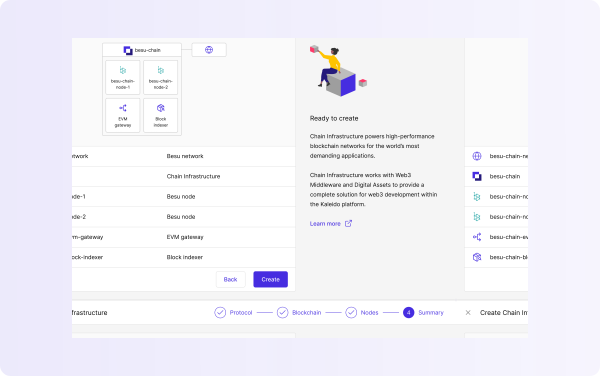
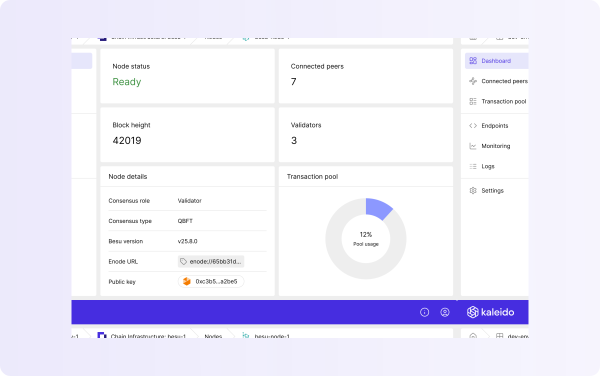


Kaleido supports both EVM and non-EVM permissioned networks including Besu, Canton, and more. Besu is EVM-compatible, so contracts and tools built for Ethereum work on your private network. Kaleido is a core enterprise maintainer of the Besu protocol, so our engineers know it down to the line of code and have direct input into its enterprise roadmap. Canton is a non-EVM network built for regulated finance, where each transaction's data is shared only with the parties involved. Kaleido is a founding member of the Canton Foundation.
Kaleido provisions a permissioned network in minutes. The platform automates node provisioning, peer discovery and consensus configuration, the steps that usually take infrastructure teams weeks by hand. The same setup scales from a small private testnet to a global consortium with hundreds of members.
Kaleido lets you run permissioned network nodes in the public cloud, in a hybrid setup, or fully self-hosted on your own premises. If data sovereignty rules require it, you can keep every node in-country on infrastructure you control, while still using Kaleido's governance and member management tools.
Kaleido's built-in member management lets existing members vote on each new participant before it joins a permissioned network. The same tools let you manage member organizations and enforce access controls as the network grows, so a consortium keeps governance in the members' hands instead of one operator's.
Kaleido is certified to ISO 27001, ISO 27017 and ISO 27018, and holds a SOC 2 Type 2 report. ISO 27017 covers security controls for cloud services, and ISO 27018 covers protecting personal data in the cloud. The same certified platform runs permissioned networks, public chain connectivity and digital asset custody.
A permissioned blockchain is a network where only approved organizations can run nodes, submit transactions or read data. Banks and consortiums choose permissioned blockchains when they need known participants, private data and governance they control. Kaleido runs permissioned networks and public chain connectivity on the same platform, so institutions can use both.
To create a private blockchain on Kaleido, you pick the protocol, choose where the nodes run and invite the member organizations. Kaleido then provisions the nodes, sets up peer discovery and configures consensus for you, work that takes weeks when done by hand. Your network can be running in minutes and grow later as members join.
A private blockchain and a permissioned blockchain are not quite the same, though people often use the terms interchangeably. Strictly, a private blockchain is run by a single organization, while a permissioned blockchain can be shared by many organizations that each need approval to join, as in a bank consortium. Kaleido supports both setups, from a single-company network to a consortium with hundreds of members.