

Are you intrigued by the concept of digital assets and their potential to transform industries? In today's digital age, traditional assets are being tokenized and digitized, creating new opportunities for businesses and investors alike.
But what exactly are digital assets, and how can they be leveraged to drive innovation and growth?
In this guide, we'll explore a variety of digital asset examples, showcasing the diverse range of assets being tokenized and the potential benefits they offer. By the end of this blog post, you'll gain valuable insights into how digital assets are reshaping the economy and how your business can capitalize on this emerging trend.
Digital assets are tokenized representations of real-world assets or digitally native assets that exist solely in digital form. These assets are typically recorded on a blockchain or distributed ledger, enabling secure ownership, transferability, and programmability.
From cryptocurrencies and tokenized securities to digital collectibles and decentralized finance (DeFi) assets, digital assets encompass a wide range of assets with varying use cases and value propositions.
Cryptocurrencies are perhaps the most well-known digital assets, serving as decentralized digital currencies that operate on blockchain networks. Examples include Bitcoin (BTC), Ethereum (ETH), and Ripple (XRP), which enable peer-to-peer transactions, store of value, and programmable smart contracts.
Tokenized securities represent traditional financial instruments such as stocks, bonds, and real estate that are digitized and issued as blockchain tokens. Examples include security tokens representing ownership in real estate properties, shares of company stock, or debt instruments like bonds.
Non-Fungible Tokens (NFTs) are unique digital assets that represent ownership or proof of authenticity of digital collectibles, artwork, and virtual assets. Examples include digital art pieces, in-game items, and virtual real estate parcels, which are traded and owned on blockchain-based platforms.
DeFi assets encompass a wide range of financial instruments and protocols built on blockchain networks, offering decentralized alternatives to traditional financial services. Examples include stablecoins, lending protocols, decentralized exchanges (DEXs), and yield farming strategies.
Tokenized commodities represent physical assets such as gold, oil, and agricultural products that are digitized and traded as blockchain tokens. Examples include gold-backed tokens that represent ownership of physical gold stored in secure vaults, providing investors with exposure to commodity markets without the need for physical ownership.
Digital assets can also represent intellectual property rights such as patents, copyrights, and trademarks, which are tokenized and recorded on blockchain networks. Examples include digital certificates of authenticity for creative works, royalty tokens for music and media rights, and licensing agreements enforced through smart contracts.
Tokenized real estate assets represent ownership or fractional ownership in real estate properties, allowing investors to access real estate markets with lower barriers to entry and increased liquidity. Examples include digital tokens representing shares of commercial properties, residential real estate portfolios, and real estate investment trusts (REITs).
Digital assets can also represent environmental assets such as carbon credits, renewable energy certificates (RECs), and biodiversity tokens, which are tokenized and traded on blockchain networks. Examples include carbon offset tokens that represent reductions in greenhouse gas emissions, incentivizing sustainable practices and environmental conservation efforts.
Digital assets are revolutionizing the way we think about ownership, value, and exchange in the digital economy. From cryptocurrencies and tokenized securities to digital collectibles and decentralized finance (DeFi) assets, the potential applications of digital assets are vast and diverse.
By exploring these digital asset examples, businesses can gain valuable insights into how they can leverage tokenization technology to innovate, streamline operations, and unlock new opportunities for growth and value creation.
Ready to explore the world of digital assets and unlock their potential for your business? Start by identifying digital asset use cases relevant to your industry and business objectives. Then schedule a talk with one of our solution architects to see how Kaleido can make it easier to accelerate your strategy.
The phrase "digital assets" covers a wide spectrum of instruments, and conflating them creates real problems for architects, legal teams, and treasury functions. A CBDC and an NFT are both digital assets in the technical sense, but they operate under different regulatory frameworks, serve different economic functions, and require different infrastructure. Getting precise about categories is the foundation of any serious implementation conversation.
Below is a reference table covering the primary categories we work with across financial institution deployments.
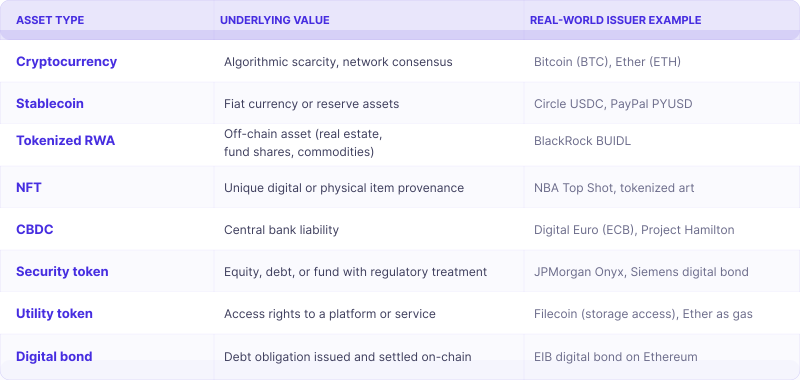
Several distinctions in this table carry operational weight. Stablecoins and CBDCs both target payment efficiency, but a CBDC is a direct central bank liability while a stablecoin is a claim on a private issuer's reserves. That difference shapes counterparty risk, regulatory treatment, and the settlement finality guarantees your legal team will care about. Security tokens and utility tokens are both issued on the same blockchain infrastructure, but only security tokens carry ownership rights and fall under securities law, which determines which token standards you need and what compliance logic must be embedded in the smart contract.
Tokenized RWAs and digital bonds share the characteristic of representing off-chain value on-chain, but their lifecycle management differs. A digital bond has defined coupon payment dates, a maturity event, and a redemption workflow that can be encoded directly into the token contract. A tokenized real estate fund has ongoing NAV calculations, subscription and redemption windows, and AML/KYC transfer restrictions that must be enforced at every secondary transfer. Both require institutional-grade infrastructure, but the programmable logic inside the token is quite different.
When enterprise architects and treasury teams ask us which asset type to use, the question almost always comes down to three dimensions: what is the underlying economic function, who are the counterparties, and what regulatory treatment applies. Matching asset type to use case before you write a line of smart contract code saves months of rework. The table below is a starting point, but the reasoning behind each mapping matters as much as the answer.
Cross-border and interbank settlement. If your goal is to move value between institutions or across borders with near-instant finality and without currency conversion friction, stablecoins and CBDCs are the natural fit. Both are designed as bearer instruments that settle atomically on-chain. JPMorgan's use of deposit tokens on Onyx is a direct example: the token represents a bank liability, moves on a permissioned ledger, and settles without a correspondent banking chain. For central bank money specifically, CBDC pilots like Project mBridge are designed for exactly this multi-currency interbank settlement problem.
Fractional ownership of illiquid assets. Real estate, private credit, infrastructure, and private equity funds all share the same structural problem: high minimum ticket sizes that exclude most investors and a secondary market that barely functions. Tokenized RWAs address this by representing fractional ownership in a programmable token. BlackRock's BUIDL fund on Ethereum is the highest-profile example, but we see this pattern in private credit platforms and commercial real estate vehicles as well. The token standard matters here: ERC-1400 and ERC-3643/T-REX are built specifically for transfer restrictions, investor whitelisting, and forced transfer capabilities that regulated securities require.
Programmable corporate actions. Security tokens are the right instrument when you need coupon payments, dividend distributions, or voting rights to execute automatically based on on-chain state. A digital bond issued under ERC-1400 can trigger coupon payments to all current token holders on a specified date without a paying agent manually processing a distribution file. The European Investment Bank's digital bond issuances demonstrate that this is production-ready infrastructure, not a proof of concept. For equity-like instruments, programmable cap table management and automated dividend waterfall logic represent genuine operational savings over legacy systems.
Loyalty, access, and incentive programs. Utility tokens are appropriate when the use case is granting access to a service or rewarding behavior rather than representing a financial claim. Airlines, retailers, and gaming platforms have explored on-chain loyalty point systems where tokens are interoperable across partner ecosystems. This is a lower regulatory burden than security tokens, but it still requires smart contract auditability and custody infrastructure.
Provenance and uniqueness. When the core requirement is proving that a specific item is authentic and tracking its ownership history, NFTs are the right structure. This applies to trade finance documents, luxury goods authentication, carbon credits (where each credit represents a specific verified offset), and digital collectibles. The non-fungible property is the feature, not a limitation.
Kaleido's Digital Assets product line is designed to handle the full lifecycle of institutional token issuance and management without requiring financial institutions to build and maintain the underlying infrastructure themselves. From token design through issuance, transfer, corporate actions, and redemption, the platform gives operations and technology teams a single environment that covers both the on-chain and off-chain dimensions of an asset's life.
The flagship product in this line is Kaleido Tokenize. Tokenize provides a no-code and API-first interface for configuring and deploying token contracts across the supported token standards we support out of the box: ERC-20, ERC-721, ERC-1155, ERC-1400, and ERC-3643/T-REX. Compliance logic such as investor whitelisting, transfer restrictions, and forced transfer for regulatory intervention is embedded at the contract level, not bolted on afterward. Tokenize also handles the corporate actions layer, so coupon payments, distributions, and maturity events are configured as part of the asset's lifecycle rather than managed through separate off-chain processes.
On the infrastructure side, institutions can deploy Kaleido in a fully managed SaaS model, on-premise on their own Kubernetes environment, or in a hybrid configuration where Kaleido hosts the platform and the customer hosts the Remote Signing Module in proximity to their HSM. All deployment models operate under our SOC 2 Type 2 and ISO 27001 certifications, and we provide a software bill of materials (SBOM) with every release. Chain connectivity spans EVM networks including Ethereum mainnet, Polygon, Arbitrum, Base, and Hyperledger Besu for permissioned deployments, as well as non-EVM chains including Bitcoin, Solana, Stellar, and Canton.
For a broader introduction to the full Digital Assets product suite, read our Digital Assets overview or explore the platform directly at kaleido.io/digital-assets.
What are the most common types of digital assets used by financial institutions today?
In our work with banks and asset managers, the most active categories are tokenized money market funds and short-duration bonds (tokenized RWAs), stablecoins used for interbank settlement, and security tokens for private credit and fund interests. CBDCs are in active pilot phases at several central banks but have not yet reached broad production deployment.
How does a tokenized bond differ from a traditional bond as a digital asset example?
A traditional bond relies on a chain of intermediaries (custodians, clearing houses, paying agents) to manage issuance, transfer, and coupon payments. A tokenized bond encodes ownership and payment obligations directly in a smart contract, so transfers settle atomically on-chain and coupon distributions can execute automatically on the payment date without a paying agent processing a file. The underlying debt obligation is the same; the operational and settlement mechanics are fundamentally different.
Are cryptocurrencies and digital assets the same thing?
Cryptocurrencies are one category within the broader set of digital assets. Digital assets include cryptocurrencies, stablecoins, tokenized real-world assets, security tokens, CBDCs, NFTs, and utility tokens. Treating the two terms as synonymous causes regulatory and architectural confusion, particularly for financial institutions where most relevant use cases involve tokenized financial instruments rather than cryptocurrencies.
What infrastructure do enterprises need to issue and manage digital assets on blockchain?
Enterprises need four core components: a blockchain network or connection to a public chain, a token contract framework that supports the relevant standard (ERC-1400, ERC-3643, or equivalent), a custody and key management layer with HSM integration for signing, and a compliance and lifecycle management layer for transfer restrictions, investor onboarding, and corporate actions. Kaleido packages all four components into a single platform with deployment options that meet institutional security and sovereignty requirements.

Kaleido makes it click-button simple to build a blockchain, launch a token, and choose your custody solution. Put our platform to work for you.
Request a DemoKaleido makes it click-button simple to build a blockchain, launch a token, and choose your custody solution. Put our platform to work for you.
Request a Demo


